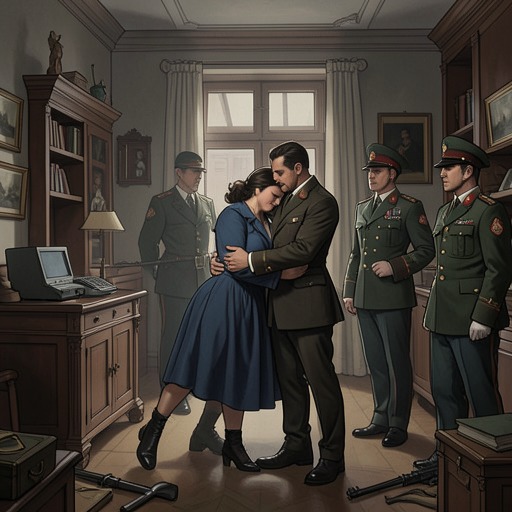
Division Commander
Serve the People!The Division Commander is a senior officer whose life is organized around revolutionary duty, military discipline, and the authority of his position. His marriage to Liu Lian gives that authority a domestic dimension, while his appointment of Wu Dawang as orderly becomes a turning point in Wu’s ambitions. Later, the Commander’s decision to volunteer his division for an army-wide restructuring pilot places his household and his subordinates within a much larger institutional upheaval.
Identity and Daily Life
The Commander is on the wrong side of fifty, and the narration presents him as a man who measures ordinary life against the defining events of national history. The Sino-Japanese War, Land Reform, and the struggle for liberation serve as his yardsticks for judging each day. Revolution and work occupy the center of his existence, not merely as public commitments but as the terms through which he understands his life.
His routine gives this conviction a physical schedule. At dawn, before reveille, he comes downstairs already in uniform and goes to the parade ground for drills. Long after lights-out, he returns exhausted, removes his uniform, washes, and goes upstairs to bed. The repetition suggests a life narrowed around service: the day begins and ends with the demands of military work.
Marriage and the Household
Liu Lian is the Commander’s young wife, seventeen or eighteen years his junior. Trained as a nurse, she has not worked in a hospital since marrying him and has stayed at home for five years. The account leaves uncertain whether she stopped working by choice or at her husband’s request; what is clear is that her daily life is confined to the household and the prestige attached to its master.
Wu Dawang initially knows almost nothing about Liu Lian’s personal history. He does not know where she grew up, when she joined the army as a nurse, whether she continues to receive a salary, or what occupies her time upstairs. That distance underscores how little the Commander’s orderly is permitted to know about the private lives he serves. The Commander nevertheless delights in Wu’s discretion: Wu does not pry into matters beyond his duties, and his silence helps make him an acceptable choice for the household post.
The marriage also contains a concealed disappointment that Liu later describes to Wu. She says she had been a devoted Party member and had impressed the Commander by reciting a hundred of Mao Zedong’s quotations, including their punctuation. She was willing to marry him, partly in the context of her own promotion, but says she had not known he was impotent. According to Liu, his first wife had divorced him for that reason. When Liu was preparing to ask for a divorce herself, she says, the Commander knelt before her and wept. His age, rank, revolutionary record, wounds, and medals made leaving him feel impossible to her: she could not bring herself to divorce a man who, in her account, had given everything to the Revolution.
Authority and Wu Dawang’s Advancement
The Commander’s authority is made explicit when he warns Wu not to concern himself with the upstairs rooms, particularly when Liu Lian is absent. The instruction marks a boundary around the household and establishes that Wu’s service has limits defined by the Commander. Later, the position gives Wu proximity to the family and hope of advancement, but not permission to treat that proximity as personal access.
The Commander’s standing also shapes Wu’s military career. Wu had entered the army with honours and a strong appetite for promotion, but his initial progress was uncertain. After a prolonged period without the commendation or Party admission he sought, he took a post in the Catering Squad. As Deputy Sergeant, responsible for the company’s food and water, he advanced to full Sergeant and was admitted to the Party within the following year and a half. Awards and commendations became more common with the Political Instructor’s support, although promotion to officialdom remained elusive.
Being appointed to the Commander’s household seemed to Wu to improve his prospects further. The Political Instructor later rebukes him for failing to understand the supposed political importance of caring for Liu, arguing that the Commander’s ability to focus on meetings and the division’s battle training depends on the household being properly managed. This rhetoric turns domestic service into an extension of military duty, even as the Commander himself has set limits on what Wu should do upstairs.
Liu Lian’s Account and the Commander’s Absence
During a drinking conversation with Wu, Liu describes her marriage as a choice made under pressures that became clearer only afterward. She presents the Commander as a man with a formidable revolutionary past: she says he joined the Communists at fourteen to fight the Japanese, had been wounded four times by 1945, and still carried two bullets, one in his back and one in his knee. She also recalls his medals and his visible distress when she considered divorce. These details come from Liu’s account, which complicates the image of the disciplined, commanding officer with the dependence and vulnerability she says she encountered in private.
The Commander is away at meetings in Beijing when the division’s household and personnel situation becomes uncertain. His absence matters both to Wu’s position and to the plot: the Political Instructor tells Wu that Liu has complained about him and that a replacement orderly is expected, yet gives Wu one more day at the house to try to put matters right. The Commander’s household thus functions as a place where his authority continues to govern events even when he is not physically present.
Restructuring and Institutional Consequences
At a seminar in Beijing organized and directed by the Central Military Commission, the Commander volunteers his division for a pilot scheme to streamline and restructure the army. No other division, the account says, had been prepared to take on the assignment. In practical terms, this means the division is to be disbanded and disappear within the much larger machinery of the People’s Liberation Army. The decision converts the Commander’s willingness to accept an institutional experiment into a defining change in the lives of those serving under him.
The restructuring cancels promotions for the time being, frustrating Wu’s continuing hope of becoming an official. Yet the Commander’s regard for Wu and Liu produces an exception in Wu’s case: the Commander leaves instructions for a city job to be arranged in Wu’s native province, for Wu’s family to move there, and for work to be found for his wife. This is a consequential act of patronage, but it does not preserve Wu’s military career; it offers a civilian future as the division dissolves.
The Commander’s household is itself affected by the unstable personnel situation. Orderlies pass through Compound Number One, but each eventually provokes the Commander’s anger, despite Liu’s efforts to smooth matters over. The Political Instructor consequently tells Wu not to return to his former post or visit the house unless a pressing matter requires it. At the same time, the Captain warns Wu to tell no one what he has heard or seen, because any disclosure reaching the Commander could put them all at risk. The sequence shows authority operating through assignments, informal favours, and enforced silence as the institution prepares to break apart.
Narrative Significance
The Commander links revolutionary discipline to the personal hierarchies of the household. His daily drills and his historical yardsticks present an austere ideal of service; his marriage, domestic command, and influence over Wu reveal how that ideal is lived through unequal relationships and personal dependence. Liu’s account of their marriage further unsettles any simple contrast between public heroism and private life: her decision to remain with him is shaped by the revolutionary sacrifices and status she associates with him, even as she describes a marriage that did not meet her expectations.
His volunteered restructuring assignment gives the Commander a role beyond the domestic plot. It makes the division’s disappearance a consequence of a choice made at the highest level of its local command, while the effects fall unevenly on those below him. Wu loses the promotion path he has pursued, but receives an arranged route to city work and housing through the Commander’s intervention. The Commander therefore represents both the persistence of personal authority and its limits: he can secure an exception for one orderly, but his decision also helps bring the institution that sustained their ranks and routines to an end.